Affiliate Disclosure: This page may contain affiliate links for home workout equipment. If you purchase through these, FitnessScopes may earn a commission to support our evidence-driven content, at no extra cost to you.
Introduction: The Rise of Home Bodyweight Training
With an increasing number of people investing in home workout equipment, choosing the right set-up for strength training can seem daunting. Among the most popular choices, the suspension trainer vs pull up bar comparison stands out for its relevance to both beginners and advanced trainees. As face-to-face gym access fluctuates and many seek more independence in their routines, portable, space-efficient devices are in demand. But which one should you select for your goals, space, and safety needs?
Bodyweight training is strongly endorsed by official health guidelines for improving muscular strength and functional fitness. The NHS and international health organisations highlight the benefits of regular strength and flexibility exercises for adults of all ages, emphasising that even simple equipment can deliver effective results when used with good form and consistency (NHS: Exercise).
Suspension Trainer: Set-Up, Evidence and Key Benefits
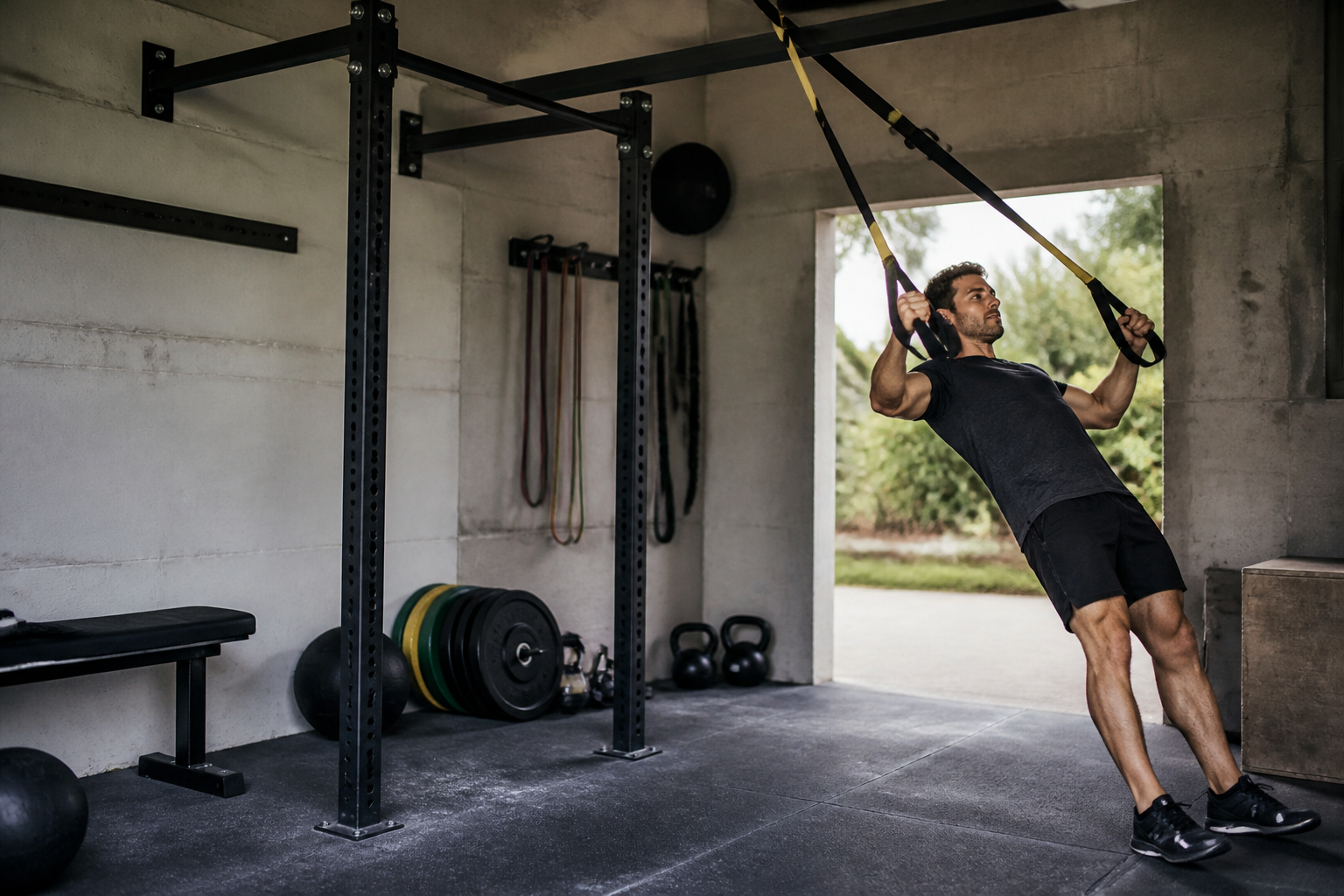
Suspension trainers—portable systems featuring handles attached to adjustable straps—offer a unique blend of instability and leverage. They can be attached to sturdy doors, rafters, or ceiling anchors, making them flexible for most home environments. Installation predominantly requires a solid fixed point with enough overhead clearance. Caution is vital: ensure the mounting point can withstand dynamic loads of your bodyweight plus added force when moving or jumping.
Research reviewed by the American College of Sports Medicine notes that suspension training provides variable resistance and core engagement across multiple planes of motion, challenging balance and coordination alongside strength (ACSM Blog). This style is praised for its versatility: station-based routines include rows, push-ups, lunges, planks, and even rotational exercises. This means a full-body workout is possible, targeting muscles from upper back to core, legs, and arms.
- Benefits: Modifiable leverage to scale difficulty, multifaceted strength and stability gains, highly portable, suitable for progression and regression.
- Considerations: Requires a secure anchor, unfamiliar moves may feel unstable at first, and space to extend your body horizontally beneath or behind the anchor is necessary.
- Safety: Check all connections before each use, avoid sharp or abrasive mounting points, and practice good hygiene. Home gym equipment—like suspension trainers—must be cleaned regularly to reduce microbial build-up (PubMed: Disinfection).
Pull-Up Bar: Set-Up, Evidence and Key Benefits
The classic pull-up bar remains a mainstay in most upper body training programmes. Installation options abound: doorway-mounted (using leverage), fixed wall-mounts, or ceiling brackets. It is vital to verify that the frame or structure can safely bear your maximum bodyweight, especially if you plan to add momentum or extra load. For some homes, drilling or permanent installation may not be feasible, in which case tension-based models are preferred but should be checked for slippage.
Pull-up bars primarily target the upper body—especially the back, arms, and shoulders—through pull-ups, chin-ups, and hanging core exercises. They excel at building strength in these muscle groups, with progressions possible through grip variations, weighted vests, or slow negatives. However, the exercise variety is somewhat more limited compared to a suspension trainer.
- Benefits: Directly develops pulling strength, excellent for upper body and grip, minimal floor space required, rapid set-up if using a doorway bar.
- Considerations: Few lower-body options, some users may struggle with basic pull-ups at first, and doorway bars may scuff paint or trim over time. Maximum load must be confirmed for all mounting types.
- Safety: Inspect grips and fixings regularly. Like all home gym surfaces, bars should be kept clean to reduce bacterial load (PubMed: Disinfection).
Practical Comparison: Versatility, Installation, Space, Progression
| Feature | Suspension Trainer | Pull-Up Bar |
|---|---|---|
| Body Regions Worked | Full-body (upper, lower, core) | Primarily upper body, core |
| Versatility | Very high (many movement patterns) | High for upper body only |
| Progression/Regression | Leverage changes make scaling easy | Grips and reps, or add/removal of assistance weight |
| Installation Complexity | Requires solid anchor, flexible location | Often simple (doorway), can be fixed/permanent |
| Portability | Highly portable, light | Portable (doorway), heavy if fixed wall-mount |
| Space Needed | Moderate – moves may require stepping out from wall | Minimal – mainly below or hanging from bar |
From a practical standpoint, suspension trainers shine in adaptability and full-body routines, filling the gap for lower-body and rotational exercises. Pull-up bars, however, remain unmatched for maximal back and arm strength. Installation ease and safety checks are essential for both but tend to favour pull-up bars when portability and fast set-up are prioritised. The suspension trainer is often the better choice for those with varied fitness levels or those wanting to train the whole body at home with one tool, while dedicated upper body progress is best achieved with a pull-up bar.
Buyer Checklist
- Training goals: Want full-body versatility? Prioritise a suspension trainer. Need maximal upper body strength? A pull-up bar is essential.
- Available space: Do you have room to move under/around your device? A pull-up bar needs less clearance.
- Installation restrictions: Renters or those wary of drilling will benefit from over-the-door models. Always check your door or beam will support required loads.
- User ability: Suspension trainers offer easier scaling for beginners and are gentler for those returning from injury. Pull-ups may be frustrating for absolute beginners, but resistance bands can help with assistance initially.
- Maintenance: Both tools require regular inspection for wear and frequent cleaning (PubMed: Disinfection), as home equipment, much like gym kit, can carry bacteria if neglected.
- Budget and portability: Suspension trainers typically cost more but are extremely transportable, while most pull-up bars are budget-friendly and compact.
FAQs and Decision Table
How do suspension trainers and pull-up bars compare for upper body and full-body workouts?
Suspension trainers offer comprehensive full-body training, including core, legs, and pushing/pulling exercises, due to their adjustable leverage and instability. Pull-up bars primarily target the upper body (back, arms, shoulders) and core with hanging movements; they are less effective for comprehensive lower-body routines.
What are the main safety and installation considerations?
Both require checking that mounting points can handle dynamic bodyweight forces. Suspension trainers must be anchored to strong beams or doors, with regular connection checks. Pull-up bars must be securely fixed or tensioned; loose fittings risk falls. Hygiene is crucial: equipment must be cleaned to limit bacterial buildup as home items can host germs, just as gym surfaces do (PubMed: Disinfection).
Which users and goals suit each equipment type best?
Suspension trainers suit those seeking all-around fitness, adaptable difficulty, and compact gear. They’re ideal for beginners, older adults, or those wanting gentle on-joint bodyweight exercise (NHS: Exercise). Pull-up bars are best for intermediate to advanced trainees focused on upper-body muscle and strength gains, or for those with limited space/resources.
| Criteria | Best for Suspension Trainer | Best for Pull-Up Bar |
|---|---|---|
| Full-body workouts | ✔ | Limited |
| Upper-body strength | Good | ✔✔ (superior) |
| Beginner-friendliness | ✔ | Assistance needed |
| Small living spaces | Variable | ✔ |
| Progression for advanced users | Good | ✔✔ |
| Portable/travel use | ✔ | ✔ (doorway type) |
References
- Suspension Training: Fact or Fiction? – American College of Sports Medicine (ACSM) (Medical Organisation)
- Exercise – NHS (Medical Organisation)
- Effect of routine disinfection on bacterial composition and load of gym equipment surfaces in Qassim region, Saudi Arabia. (Peer-Reviewed)