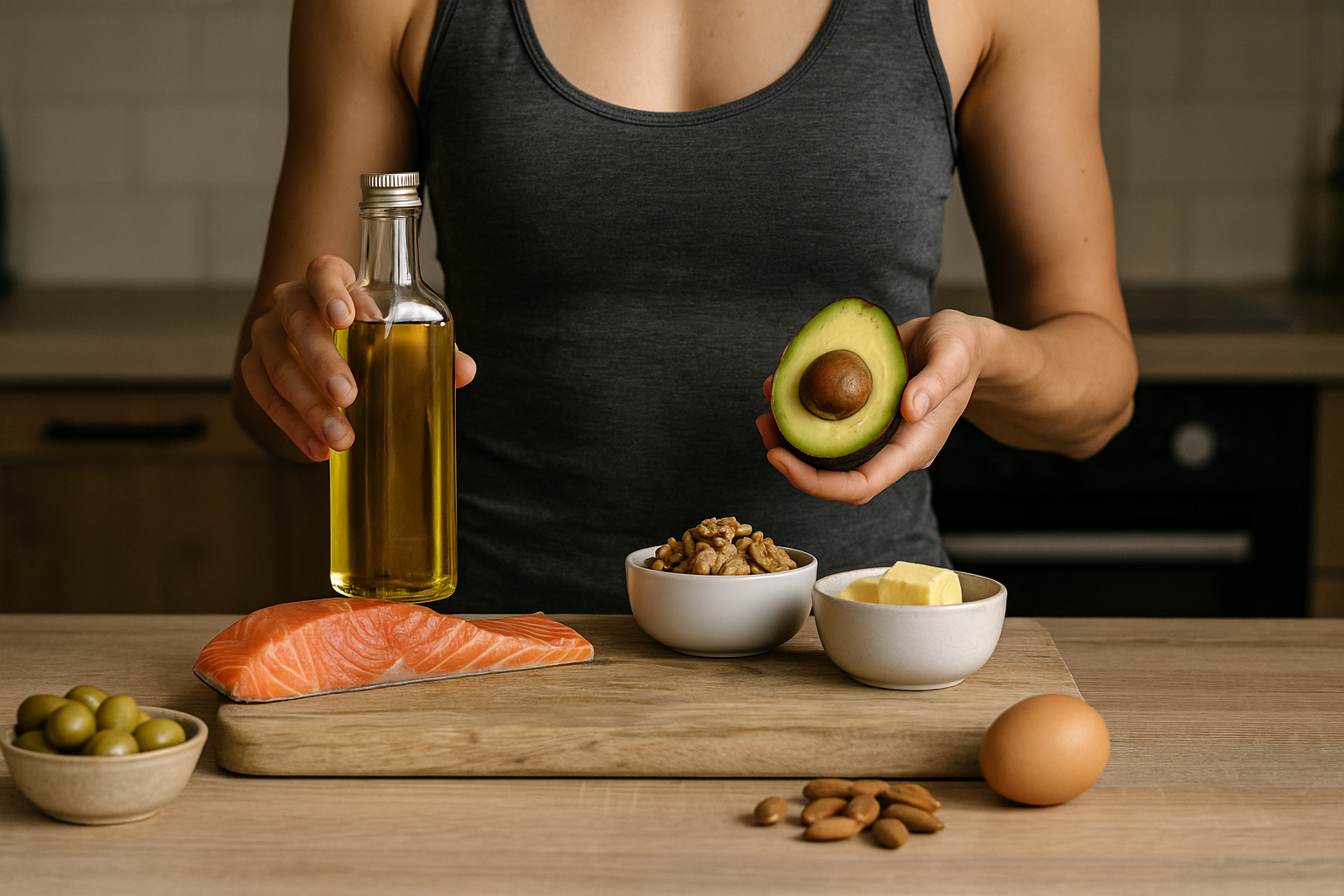
What does dietary fat do?
Fat supplies energy, provides essential fatty acids, forms part of cell membranes and helps the body absorb the fat-soluble vitamins A, D, E and K. Fat also contributes flavour and texture to food.
Types of dietary fat
Unsaturated fats
Monounsaturated and polyunsaturated fats are found in foods such as olive oil, nuts, seeds, avocado and oily fish. Replacing some saturated fat with unsaturated fat is consistent with major cardiovascular-health guidance.
Saturated fat
Saturated fat is found in foods including fatty meats, butter, cheese, coconut oil and many baked or processed foods. WHO guidance recommends limiting saturated fat and replacing it primarily with unsaturated fats rather than refined carbohydrate.
Trans fat
Industrially produced trans fats have particularly adverse cardiovascular effects and major health organisations recommend keeping intake as low as possible.
How much fat do active adults need?
There is no special ultra-low-fat requirement for fitness. Sports-nutrition guidance generally keeps fat intake within a moderate proportion of total energy while ensuring essential fatty acids and fat-soluble vitamins are supplied. Very low-fat diets can make it harder to meet these needs.
Fat and exercise fuel
Fat is an important fuel at rest and during lower-intensity exercise. As exercise intensity rises, carbohydrate becomes increasingly important. Training can improve the ability to use fat during exercise, but that does not mean eating more fat automatically improves performance or body-fat loss.
Fat before a workout
Large high-fat meals digest slowly and may be uncomfortable immediately before hard training. That is a timing issue, not a reason to avoid dietary fat throughout the day. A mixed meal several hours before training is different from eating a large fatty meal just before exercise.
Omega-3 fats
Long-chain omega-3 fatty acids EPA and DHA are found mainly in oily fish and seafood, while alpha-linolenic acid is found in plant foods such as flax, chia and walnuts. Omega-3 fats are important nutrients, but supplement claims should be evaluated separately from the benefits of a balanced diet.
Does eating fat make you gain body fat?
Dietary fat contains about 9 kcal per gram, making it more energy dense than protein or carbohydrate. But body-fat change depends on energy balance over time, not on the presence of one macronutrient. High-fat and lower-fat eating patterns can both be compatible with different goals when total intake is appropriate.
Practical food choices
- Use olive, rapeseed or other unsaturated oils where appropriate.
- Include nuts, seeds and avocado in portions that fit your energy needs.
- Include oily fish if it suits your diet.
- Consider the whole food rather than judging it only by grams of fat.
- Keep highly processed foods rich in saturated fat and salt in context of the overall diet.
Common misconceptions
- “Low-fat always means healthier.” A low-fat product can still be nutrient-poor.
- “Eating fat stops fat loss.” Energy balance matters.
- “Coconut oil is uniquely healthy.” Coconut oil is high in saturated fat and should not be treated as nutritionally equivalent to unsaturated oils.
- “More omega-3 supplement is always better.” Supplements have dose, interaction and quality considerations.
FAQs
Do athletes need dietary fat?
Yes. Fat provides essential fatty acids, energy and supports absorption of fat-soluble vitamins.
Should I avoid fat before exercise?
Not necessarily, but very high-fat meals close to hard exercise can cause gastrointestinal discomfort for some people.
Is all saturated fat poisonous?
No. The useful public-health question is the overall amount and what replaces it in the diet.
Are nuts too high in calories?
Nuts are energy dense but also nutrient dense. Portion size can be adjusted to fit individual energy needs.