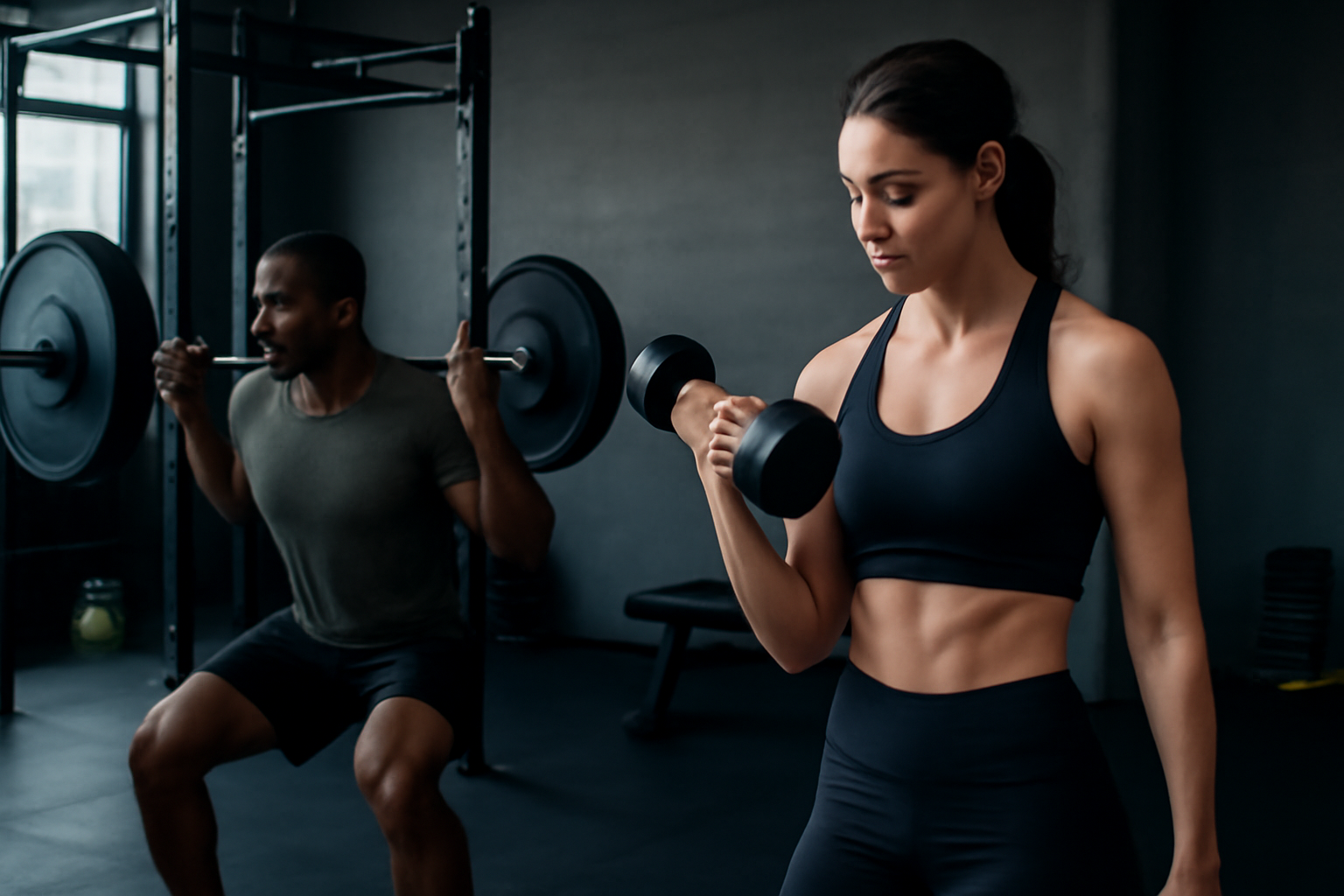
Compound and isolation exercises are not competing training methods. They are different tools. Compound movements involve more than one joint and usually train several muscle groups at once; isolation movements primarily use one joint to place more focused work on a particular muscle.
For most people, an effective resistance-training programme can use both. The useful question is not “Which type is better?” but “Which exercise best serves the goal of this part of the workout?”
Compound vs isolation at a glance
| Compound exercises | Isolation exercises | |
|---|---|---|
| Joint action | Multiple joints | Primarily one joint |
| Examples | Squat, bench press, row, pulldown | Biceps curl, leg extension, lateral raise |
| Main advantage | Train several muscles efficiently | Target a muscle with focused work |
| Typical role | Foundation of many programmes | Add volume or target specific muscles |
| Loading | Often permits greater absolute loads | Usually uses lower absolute loads |
| Skill/fatigue | Can require more coordination and create broader fatigue | Often simpler and more locally fatiguing |
What is a compound exercise?
A compound, or multi-joint, exercise involves meaningful movement at more than one joint. During a squat, for example, the hips, knees and ankles contribute. A bench press combines movement at the shoulder and elbow.
Common examples include:
- squats and leg presses;
- deadlift and hip-hinge variations;
- bench presses and push-ups;
- overhead presses;
- rows;
- pull-ups and pulldowns;
- lunges and split squats.
Because several muscles contribute, compound exercises are an efficient way to train much of the body with a relatively small exercise list.
What is an isolation exercise?
An isolation, or single-joint, exercise primarily moves one joint while targeting a smaller set of muscles. “Isolation” does not literally mean only one muscle is active; human movement rarely works that way. The term describes the exercise's more focused role.
Examples include:
- biceps curls;
- triceps extensions;
- leg extensions;
- leg curls;
- calf raises;
- lateral raises;
- pec fly variations.
Which is better for building muscle?
Both can contribute to muscle growth. Compound exercises let you train several muscles at once, while isolation exercises make it easier to add focused work without repeating another large multi-joint movement.
A systematic review and meta-analysis comparing single-joint and multi-joint resistance exercises found broadly similar whole-muscle hypertrophy outcomes in the limited available evidence, while noting that the research base has important limitations. Exercise selection should therefore reflect the muscle you want to train, the movement's stimulus, comfort and the rest of the programme rather than a blanket rule that one category always produces more growth.
There can also be regional differences. A compound exercise may not challenge every contributing muscle equally through its most useful range. That is one reason bodybuilders commonly combine presses with triceps work, rows/pulldowns with curls, and squats or presses with leg extensions or curls.
Which is better for strength?
Strength is specific to the task being tested. If your goal is to improve a squat, bench press or another multi-joint lift, practising that movement or a close variation matters. Isolation work can strengthen individual muscles that contribute to those lifts, but a stronger leg extension does not automatically teach the coordination required for a heavy squat.
For general strength rather than a specific lift, a mixture of exercises can be used. The American College of Sports Medicine's 2026 resistance-training update emphasises that many forms of resistance training are effective and that consistency is more important than unnecessary programme complexity for the average healthy adult.
Why compound exercises are useful
- Time efficiency: one movement can train several muscle groups.
- Skill practice: useful when the multi-joint movement itself is a training goal.
- Progress tracking: common lifts are straightforward to log over time.
- Programme simplicity: a small number of movements can cover the major muscle groups.
The trade-off is that compound exercises can create more systemic fatigue and require more coordination. The muscle you want to emphasise may also stop being the limiting factor if another muscle or your technique fails first.
Why isolation exercises are useful
- Targeted volume: add work for a muscle without repeating another large compound lift.
- Addressing programme gaps: directly train areas receiving relatively little work from your main movements.
- Lower skill demand: many machine and cable isolation exercises are simple to learn.
- Fatigue management: focused work can sometimes be added without the whole-body demand of another compound exercise.
Isolation exercises are not merely “finishing” exercises, and they are not inherently less functional. Their usefulness depends on the goal.
Should beginners do isolation exercises?
Yes, but beginners usually benefit from keeping the programme manageable. A small selection of compound movements can efficiently cover the body, then one or two isolation exercises can be added for muscles you want to emphasise.
For example, a beginner session might include a leg press, Romanian deadlift, chest press, row and pulldown, followed by a lateral raise or curl. That is easier to learn and track than trying to perform a separate exercise for every muscle.
See our Strength Training for Beginners guide for a complete starting framework.
Do compound exercises have to come first?
Not always. Exercises placed earlier in a session are generally performed when you are less fatigued, so prioritise what matters most to your goal. If improving a squat is the priority, squatting early makes sense. If a specific muscle is the main priority, a targeted exercise may sometimes be placed earlier.
For a general beginner workout, larger multi-joint movements first and smaller isolation movements later is a simple default, not an unbreakable rule.
Example: combining both in one workout
| Exercise | Type | Purpose |
|---|---|---|
| Leg press | Compound | Quads, glutes and lower-body work |
| Romanian deadlift | Compound | Hip hinge / posterior-chain work |
| Dumbbell bench press | Compound | Chest, triceps and anterior shoulder |
| Cable row | Compound | Back and elbow-flexor work |
| Leg curl | Isolation | Focused knee-flexion work for hamstrings |
| Lateral raise | Isolation | Focused shoulder work |
| Biceps curl | Isolation | Focused elbow-flexor work |
How many exercises do you actually need?
There is no required compound-to-isolation ratio. Start with the minimum exercise selection that covers your goals and that you can progress consistently. Add exercises when they solve a specific programming problem rather than because a workout feels too short.
Your sets, repetitions and weekly workload also matter. Read Sets and Reps Explained and Progressive Overload Explained before simply adding more movements.
Common misconceptions
“Compound exercises build mass; isolation exercises create definition”
Exercise type does not create “definition” independently of muscle size and body-fat level. Isolation exercises can build muscle, and compound exercises can build muscle. Their main distinction is how the movement distributes work.
“Free-weight compounds are always more functional”
Function is goal-specific. A machine or single-joint exercise can be highly useful if it improves the capacity you care about. Equipment choice should account for goals, accessibility, comfort and progression.
“Isolation exercises are only for advanced lifters”
Beginners can use them. The reason to limit exercise count early is programme simplicity, not because isolation movements are forbidden.
Frequently asked questions
Are squats a compound exercise?
Yes. Squat variations involve movement at multiple joints and recruit several lower-body muscle groups.
Are biceps curls isolation exercises?
They are generally classified as single-joint isolation exercises because elbow flexion is the primary joint action.
Can you build muscle using only compound exercises?
You can build substantial muscle with compound movements, but targeted single-joint exercises can help add work for muscles that receive less stimulus or need more emphasis.
Can you train using only isolation exercises?
It is possible to create resistance with single-joint movements, but doing so may require many exercises to cover the whole body. Compound movements are often more time-efficient.
The bottom line
Compound exercises efficiently train multiple muscles and are a useful foundation for many programmes. Isolation exercises provide targeted work and can fill gaps, manage fatigue or emphasise specific muscles. Most trainees do not need to choose between them: use each where it serves the programme.