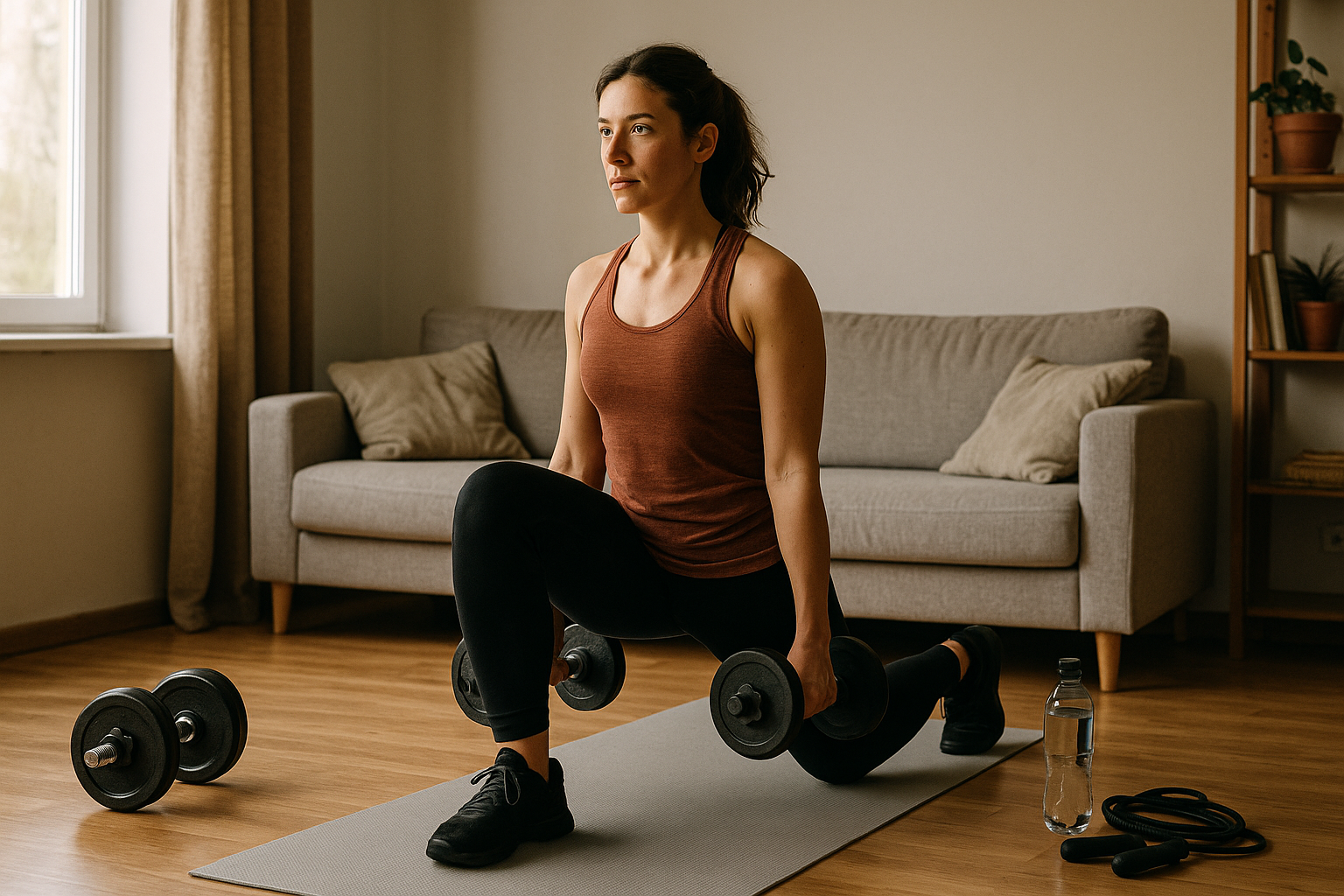
A pair of dumbbells can cover most major movement patterns at home. The key is not owning dozens of weights; it is selecting movements you can repeat and progressing them despite limited load.
Workout A
| Exercise | Sets × reps |
|---|---|
| Goblet squat | 3 × 8–12 |
| Dumbbell floor press | 3 × 8–12 |
| One-arm row | 3 × 8–15/side |
| Romanian deadlift | 3 × 8–12 |
| Standing press | 2 × 8–12 |
| Loaded carry or trunk exercise | 2–3 sets |
Workout B
| Exercise | Sets × reps |
|---|---|
| Split squat | 3 × 8–12/side |
| Push-up or floor press | 3 × 8–15 |
| Dumbbell row | 3 × 8–15 |
| Single-leg RDL | 2–3 × 8–12/side |
| Lateral raise | 2 × 10–20 |
| Dead bug | 2–3 sets |
Two- and three-day schedules
For two days, perform A then B. For three days, alternate A/B/A one week and B/A/B the next.
Double progression
Use a rep range. When you can reach the top of that range with good technique across all prescribed sets, increase the dumbbell load if possible and rebuild repetitions.
If your dumbbells are too light
Use unilateral versions, larger comfortable ranges of motion, additional repetitions, extra sets or movements with less favourable leverage. Slowing a repetition can improve control, but deliberately slow tempo is not a substitute for progressive resistance forever.
Rest
Rest enough to preserve performance. Compound exercises may need two minutes or more; smaller exercises may need less.
Do you need a bench?
No. Floor pressing, standing pressing, rows, squats, hinges and split squats can all be performed without one.
Affiliate note
FitnessScopes does not currently maintain a verified dumbbell/equipment affiliate catalogue. We therefore do not insert an unrelated supplement CTA into this programme.
FAQs
Can I get strong with only dumbbells?
Dumbbells can support substantial strength and muscle development, although very advanced maximal-strength goals may eventually require heavier loading options.
How heavy should my dumbbells be?
Heavy enough that the target rep range is challenging with controlled technique. There is no single beginner weight.
Can I do dumbbell full body three times weekly?
Yes, provided total volume and effort allow recovery.
The bottom line
A small dumbbell setup can support a complete programme. Track sets and reps and use progressive overload rather than constantly replacing the routine.
How to apply this in your programme
Use the principle in this guide as one part of a complete training plan rather than as an isolated rule. Start with a workload you can perform with consistent technique, record what you actually complete, and make small changes only when recovery and performance support them. Progress can come from additional repetitions, slightly more resistance, greater range of motion, better control, longer duration or more demanding exercise selection depending on the goal.
A useful programme also separates hard sessions with enough recovery and keeps the majority of weekly work repeatable. If performance falls sharply from session to session, soreness consistently interferes with normal training, or technique deteriorates, adding more work is unlikely to be the best first response.
Tracking progress without overcomplicating it
Choose a small number of measures that match the goal. For resistance training, useful records include exercise, load, repetitions, sets and perceived effort. For aerobic work, duration, distance, pace or power and session effort can provide context. Mobility work is better judged by whether the required movement becomes more comfortable and controllable, not simply by forcing a larger passive range.
Compare trends across several sessions rather than treating one unusually good or bad workout as proof that the programme is working or failing. Sleep, stress, heat, nutrition and accumulated fatigue can all influence a single session.
Common mistakes
- Changing several training variables at once, making it difficult to identify what helped.
- Adding volume simply because a session felt easy rather than following a planned progression.
- Copying advanced routines before building tolerance to the basic movements and weekly workload.
- Using soreness as the main measure of training quality.
- Ignoring pain or repeatedly training through a movement that cannot be performed with reasonable control.
When to modify the plan
Training should be adjusted to the individual. Exercise selection can be changed around equipment, experience and movement limitations while preserving the underlying training goal. Persistent or worsening pain, unexplained loss of function, chest pain, fainting or other concerning symptoms are reasons to stop relying on generic online programming and seek appropriate professional assessment.