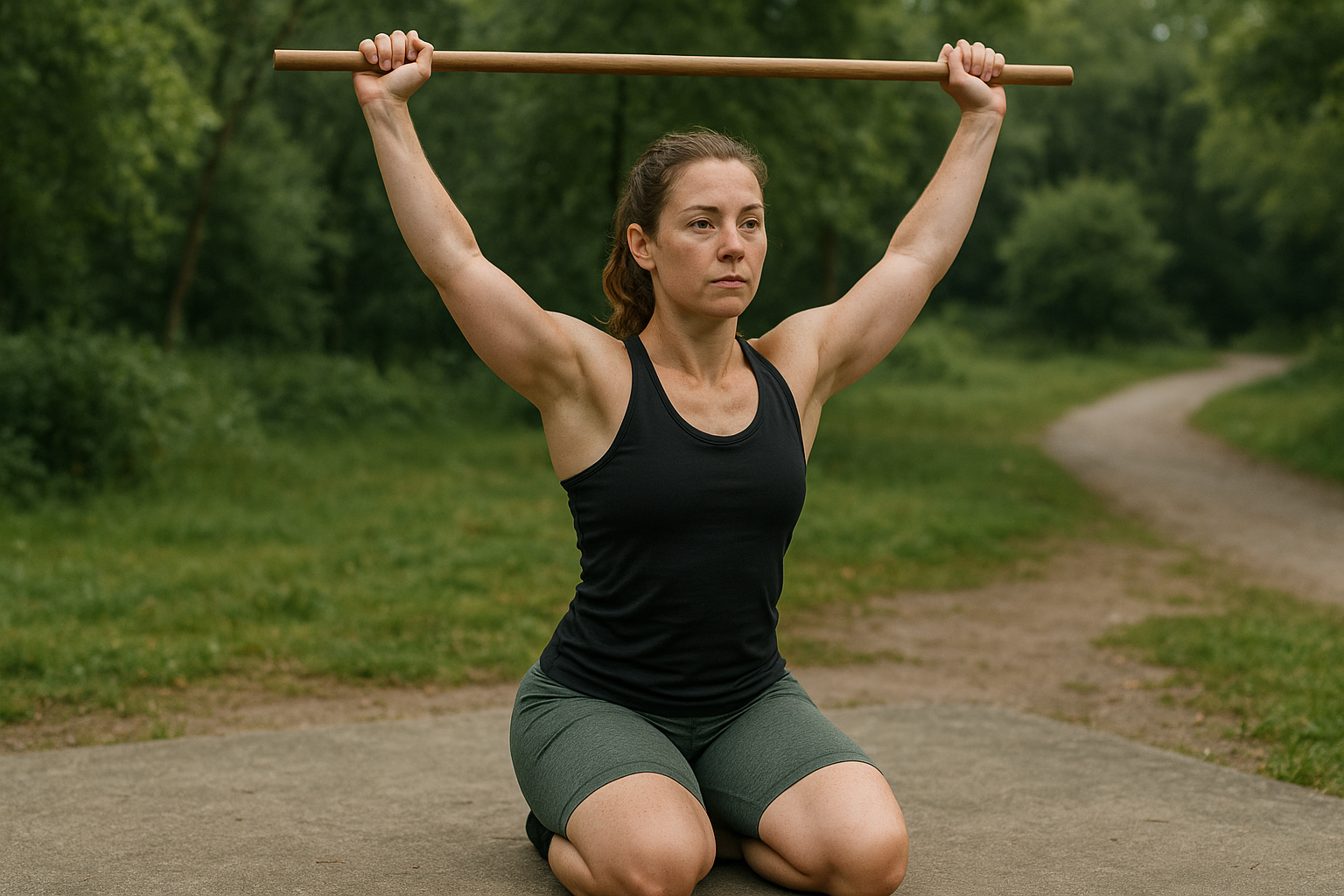
Overhead movement involves more than the ball-and-socket shoulder joint. The shoulder blade, upper back, ribcage and muscular control all contribute. A useful mobility routine therefore focuses on the movement task rather than trying to isolate one “tight” tissue.
What contributes to overhead motion?
Arm elevation combines glenohumeral motion with scapular upward rotation and other coordinated movement. Thoracic position can also influence how an overhead position feels and looks.
Wall slides
Stand or kneel facing a wall and slide the forearms upward while allowing the shoulder blades to move naturally. Use a range you can control without forcing pain.
Open-book rotations
Side-lying thoracic rotation can expose the upper back to rotational movement. Keep the drill controlled rather than forcing the hand to the floor.
Active overhead raises
Raise the arms overhead while keeping a comfortable ribcage position, then lower slowly. Light resistance can later be added to strengthen the range.
Loaded overhead work
Pressing variations can develop strength through overhead ranges when appropriate. Landmine presses or angled pressing may provide an alternative when straight overhead work is not currently comfortable.
Stretching
Stretching the latissimus dorsi, chest or other tissues may increase range when those tissues contribute to the limitation, but a generic stretch cannot identify the cause of restricted or painful movement.
When not to self-treat
Persistent shoulder pain, instability, traumatic injury, marked weakness or neurological symptoms warrant appropriate assessment rather than increasingly aggressive mobility drills.
FAQs
How can I improve overhead mobility?
Practise relevant controlled ranges, address flexibility where it is actually limited and strengthen the positions you need.
Is poor overhead movement always tight shoulders?
No. Multiple joints, tissues, coordination and individual anatomy contribute.
Should shoulder mobility drills hurt?
No. Do not use pain as the target of a mobility drill.
The bottom line
Train overhead mobility as a coordinated movement. Build usable range and strength rather than chasing a single stretch or blaming one tissue.
How to apply this in your programme
Use the principle in this guide as one part of a complete training plan rather than as an isolated rule. Start with a workload you can perform with consistent technique, record what you actually complete, and make small changes only when recovery and performance support them. Progress can come from additional repetitions, slightly more resistance, greater range of motion, better control, longer duration or more demanding exercise selection depending on the goal.
A useful programme also separates hard sessions with enough recovery and keeps the majority of weekly work repeatable. If performance falls sharply from session to session, soreness consistently interferes with normal training, or technique deteriorates, adding more work is unlikely to be the best first response.
Tracking progress without overcomplicating it
Choose a small number of measures that match the goal. For resistance training, useful records include exercise, load, repetitions, sets and perceived effort. For aerobic work, duration, distance, pace or power and session effort can provide context. Mobility work is better judged by whether the required movement becomes more comfortable and controllable, not simply by forcing a larger passive range.
Compare trends across several sessions rather than treating one unusually good or bad workout as proof that the programme is working or failing. Sleep, stress, heat, nutrition and accumulated fatigue can all influence a single session.
Common mistakes
- Changing several training variables at once, making it difficult to identify what helped.
- Adding volume simply because a session felt easy rather than following a planned progression.
- Copying advanced routines before building tolerance to the basic movements and weekly workload.
- Using soreness as the main measure of training quality.
- Ignoring pain or repeatedly training through a movement that cannot be performed with reasonable control.
When to modify the plan
Training should be adjusted to the individual. Exercise selection can be changed around equipment, experience and movement limitations while preserving the underlying training goal. Persistent or worsening pain, unexplained loss of function, chest pain, fainting or other concerning symptoms are reasons to stop relying on generic online programming and seek appropriate professional assessment.