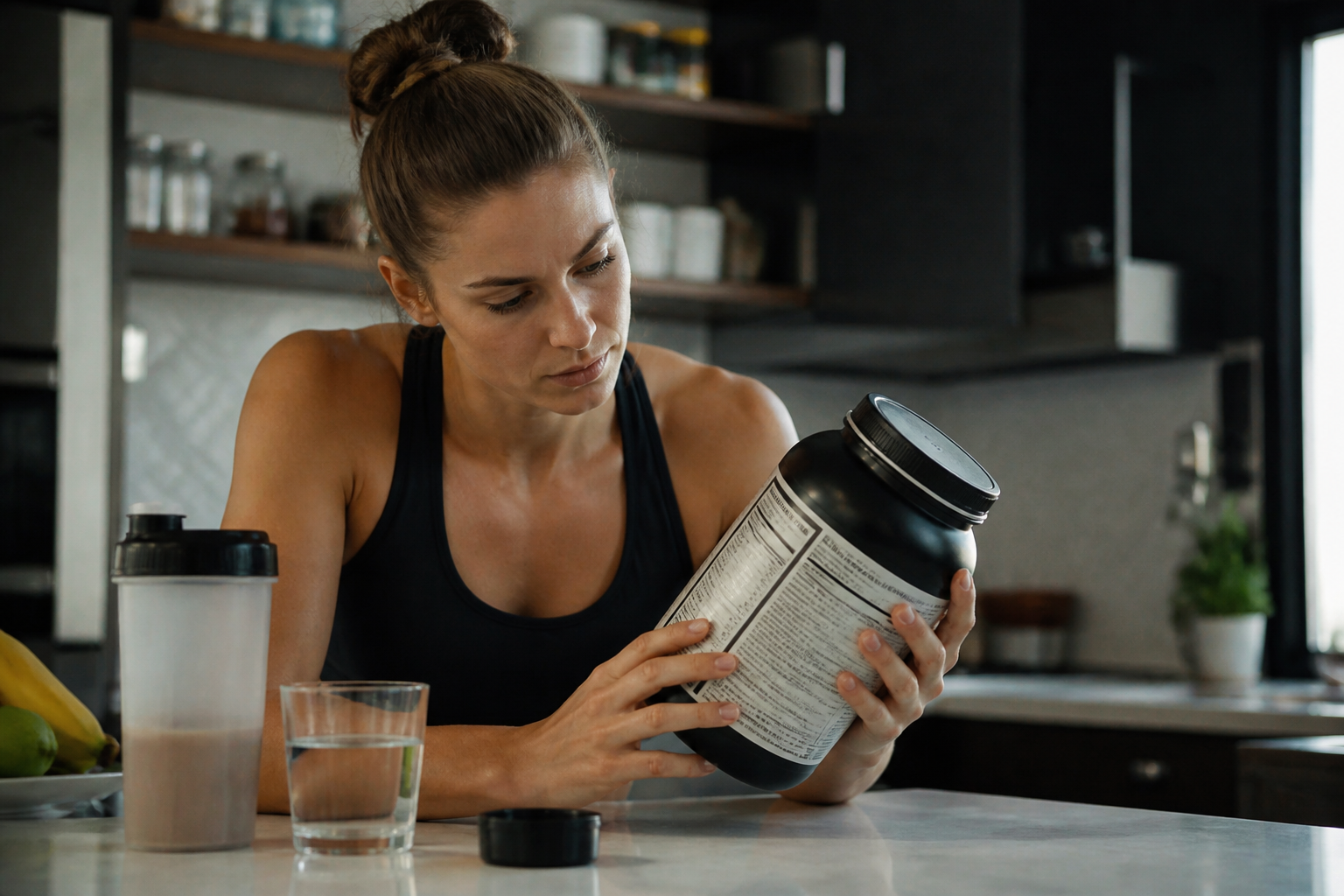
How we evaluate supplement options
FitnessScopes separates ingredient evidence from product marketing. A product is not treated as effective simply because it contains a familiar ingredient. We check the intended outcome, human evidence, dose, formulation, label transparency, safety information and product verification.
Quick decision framework
- Define the exact outcome you want.
- Check whether an ingredient has relevant human evidence.
- Compare the studied dose with the labelled dose.
- Check total caffeine or overlapping nutrients across products.
- Review warnings and interactions.
- Prefer transparent labels over unexplained proprietary blends.
- For tested athletes, consider credible third-party certification.
Start with the ingredient, not the promise
Terms such as fat burner, recovery formula or performance matrix are marketing categories. The useful questions concern the individual ingredients and whether the complete formula matches the evidence.
Evidence and limitations
Some ingredients, such as creatine monohydrate and caffeine for specific performance outcomes, have substantial research. Others have mixed or limited evidence. Even strong ingredient evidence does not guarantee that every commercial formula supplies the same form or dose used in research.
Label transparency
Check serving size, amount per serving and directions. Proprietary blends can obscure individual quantities. Multiple products can also duplicate caffeine, vitamins, minerals or herbal stimulants.
Product quality
Manufacturing and contamination matter. Third-party certification can provide additional quality assurance, particularly for competitive athletes, although it does not prove a product will improve performance.
Buying considerations
Price per serving is only useful after checking dose. A cheaper product can be poor value if it supplies too little of the relevant ingredient, while a complex premium blend can be unnecessary when a simpler single-ingredient product meets the goal.
About our product coverage
FitnessScopes only publishes product-specific commercial pages when product facts have been verified. Where official assets have not been verified, we do not invent packaging or imply that an unofficial image is supplied by the manufacturer.
Affiliate disclosure
Some product links on FitnessScopes may be affiliate links. This can result in a commission if a purchase is made, at no additional cost to the reader. Affiliate status does not change the evidence standard used to describe an ingredient or product.
FAQs
What is the best sports supplement?
There is no single product that is appropriate for every goal. The relevant choice depends on the intended outcome, evidence, dose, safety and whether supplementation is needed.
Does third-party testing mean a supplement works?
No. Testing can address aspects of identity or contamination; it does not establish effectiveness.
Are proprietary blends always bad?
Not automatically, but they can make it impossible to compare individual ingredient doses with research.
Should beginners buy supplements?
Supplements are optional. Training, adequate nutrition and sleep are higher priorities.
How to apply this in your programme
Use the principle in this guide as one part of a complete training plan rather than as an isolated rule. Start with a workload you can perform with consistent technique, record what you actually complete, and make small changes only when recovery and performance support them. Progress can come from additional repetitions, slightly more resistance, greater range of motion, better control, longer duration or more demanding exercise selection depending on the goal.
A useful programme also separates hard sessions with enough recovery and keeps the majority of weekly work repeatable. If performance falls sharply from session to session, soreness consistently interferes with normal training, or technique deteriorates, adding more work is unlikely to be the best first response.
Tracking progress without overcomplicating it
Choose a small number of measures that match the goal. For resistance training, useful records include exercise, load, repetitions, sets and perceived effort. For aerobic work, duration, distance, pace or power and session effort can provide context. Mobility work is better judged by whether the required movement becomes more comfortable and controllable, not simply by forcing a larger passive range.
Compare trends across several sessions rather than treating one unusually good or bad workout as proof that the programme is working or failing. Sleep, stress, heat, nutrition and accumulated fatigue can all influence a single session.
Common mistakes
- Changing several training variables at once, making it difficult to identify what helped.
- Adding volume simply because a session felt easy rather than following a planned progression.
- Copying advanced routines before building tolerance to the basic movements and weekly workload.
- Using soreness as the main measure of training quality.
- Ignoring pain or repeatedly training through a movement that cannot be performed with reasonable control.
When to modify the plan
Training should be adjusted to the individual. Exercise selection can be changed around equipment, experience and movement limitations while preserving the underlying training goal. Persistent or worsening pain, unexplained loss of function, chest pain, fainting or other concerning symptoms are reasons to stop relying on generic online programming and seek appropriate professional assessment.